Your Cart is Empty

The original GT America class deserves recognition not only for what it was, but for what it became. Conceived in the mid-1990s by Steve Archer, Mitch Wright, and Ron Cortez, GT America was built on a simple but ambitious idea: to create a durable, V8-powered road racing car that delivered real performance without the escalating costs already reshaping club and professional racing. Drawing from proven American Speed Association (ASA) oval-track machinery and adapting it for road courses, the class established a blueprint prioritizing accessibility, mechanical parity, and driver development—principles that continue to define successful American road racing today.
Over time, that blueprint evolved. Through periods of growth, dormancy, and reinvention, the core concepts of GT America carried forward, refined through continued development and real-world competition. Those concepts ultimately resurfaced as the foundation of the modern TA2 class, providing Trans Am with a sustainable and competitive category that helped fuel the series’ revival. This was not a coincidence, nor a restart; it was a direct and traceable line of evolution.


Central to that progression was Howe Racing Enterprises. From its early involvement in GT America car construction to continued chassis development during Trans Am’s dormant years—and later international adaptations of the concept—Howe ensured the platform never stagnated. When TA2 emerged, it did so with Howe-built cars at its core, translating years of accumulated knowledge into a modern, highly successful package that remains the benchmark of the class today.
In recent years, the reuse of the GT America name by an entirely separate racing series has unintentionally obscured this history. That modern series shares only a name, not a lineage. The original GT America class was neither replaced nor forgotten; it evolved. Its legacy lives on every time a TA2 car takes the green flag.
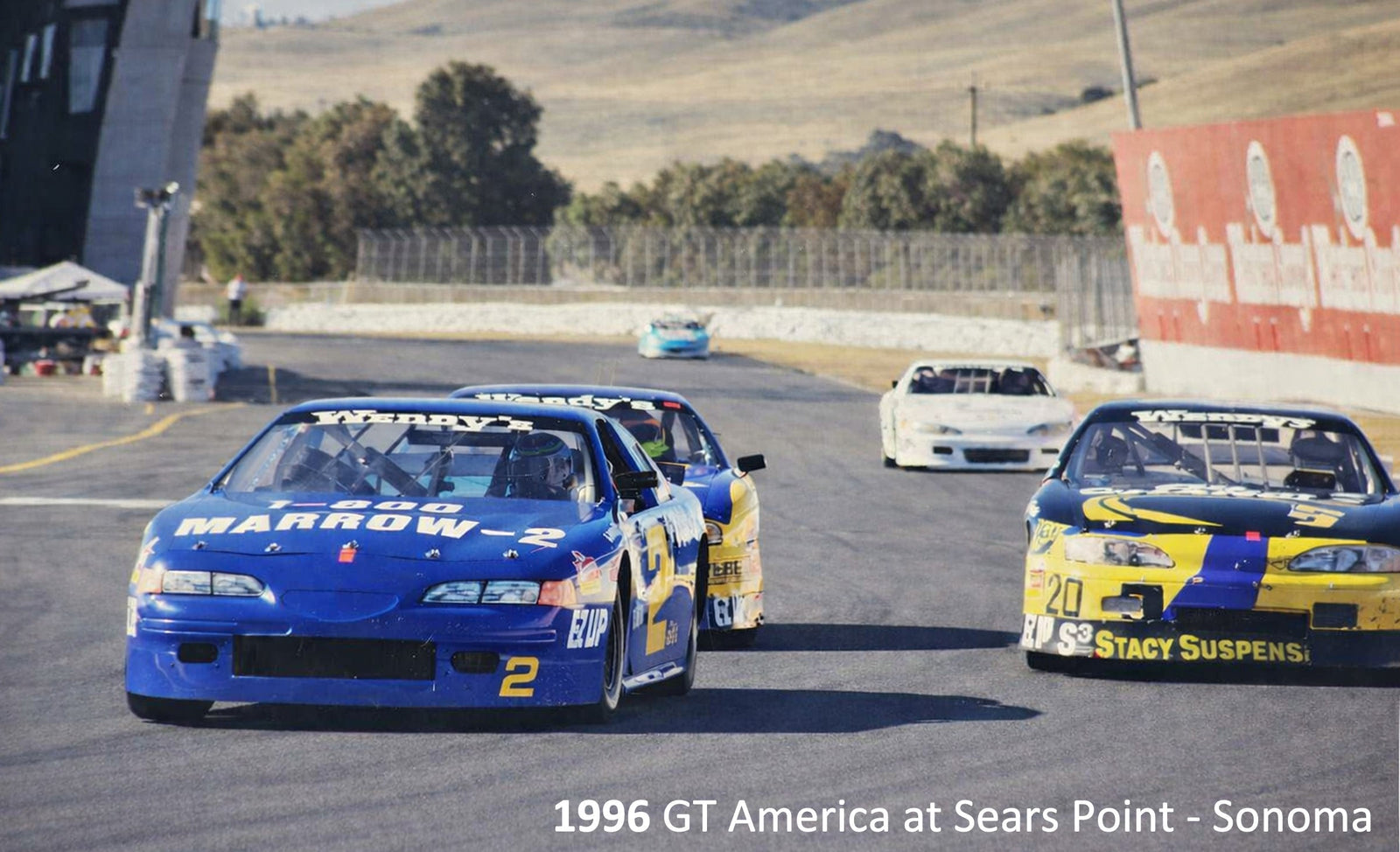
In 1994, California Wendy’s franchise owner Steve Archer teamed up with Mitch Wright and Ron Cortez to adapt oval-track cars from the American Speed Association—built by Howe Racing Enterprises—for SCCA road racing, leading to the creation of the GT America class.

Mitch Wright recalled, “Steve and I discussed a V8-powered race car that would not break the bank. I mentioned the ASA cars, and he lit up.” Wright leveraged experience gained racing with his brother-in-law, Leighton Reese, who campaigned a Howe ASA car and later converted it to compete in Trans Am events. “When the GTA class formed, I suggested Howe as a source for cars.”
The GTA class featured ASA-based bodies including the Chevrolet Lumina, Monte Carlo, Pontiac Grand Prix, Dodge Intrepid, Oldsmobile Cutlass, Ford Thunderbird, and Ford Taurus. Wright continued, “Steve, Ron, and I compiled the rules for a club racing series, and the first GT America race took place in May of 1995 at Sonoma. I later joined SCCA, while Ron took over GTA and continued to work closely with Howe. Ron was key in getting the cars to run with Trans Am on the West Coast, and I was encouraging Trans Am’s John Clagett to add more events, which they did in 1997—though those efforts were later discontinued.” Following the 2005 season, Clagett left Trans Am when Champ Car ended its association with the series.

During Trans Am’s 2007–2008 dormancy, Howe created a version of the GT America–based car for the Dutch DNRT V8 series. The adaptable chassis soon drew international attention. Sweden’s Camaro Cup Series co-directors Hans Emeren and Tony Bryntesson asked Howe to combine the DNRT chassis with the fifth-generation Camaro body, resulting in a fiberglass Camaro that debuted at Mantorp Park, Sweden in 2009.
Concurrently, with Greg Pickett's support, TA team owner Jim Derhaag persuaded SCCA and President Bob Wildberger to bring back Trans Am. As Trans Am prepared for revival, former GTA competitor Greg Rodgers proposed reintroducing the class. “In 2010, I proposed adding GTA back to SCCA, but at first Derhaag wasn’t interested. We discussed possibly renaming GTA as Trans Am Challenge, but Wildberger felt that was too similar to World Challenge and suggested TA2. I showed them photos of the Howe-built Swedish Camaros, and they loved them—they thought that look was exactly what TA2 needed. They asked how many cars I could get to Petit Le Mans at Road Atlanta.”

Chas Howe, who was involved from the original GT America cars through the modern TA2 platform, explained, “The goal from the beginning was never to create a finished product—it was to adapt the most successful elements of prior experience to new opportunities. TA2 wasn’t designed to replace GT America, nor was it the brainchild of any one person; it was a well-timed convergence of people and ideas.”
The successful 2010 Petit Le Mans event confirmed TA2’s potential. Rodgers and Bob Stretch debuted Howe’s Camaro Cup cars at Sebring in 2011. Soon after, Jim Derhaag invited Chas Howe to Road America to explain the Camaro Cup car to other TA team owners. Derhaag assembled an ownership group to purchase control of Trans Am from SCCA Pro and then hired back John Clagett. Clagett explained, "Derhaag called me in 2011 and asked if I'd come back to work for the series. That deal was put in place in August of 2011, and I started working on the 2012 schedule." TA2 quickly replaced the remaining GT America cars, with Howe-built chassis leading the way.


In early 2013, Trans Am invited TA2 bids from additional car builders. In addition to Howe, Trans Am diversified the chassis specifications by approving four new builders: Cope, M1, Meissen, and little-remembered Overtime Racing. Mike Cope, who prepared a Port City Late Model perimeter car for the TA2 debut event at Petit Le Mans in 2010, submitted a similar car in 2013, while M1 brought a converted Townsend NASCAR Late Model stock, and Mark Miesen produced a design influenced by his Trans-Am chassis.
Today, TA2 operates with three remaining approved builders competing in multiple championships across the United States. For competitors seeking to race at the highest levels of North American road racing, Howe Racing Enterprises continues to represent the standard in TA2 performance, engineering, and support. The GT America story is not one of failure, but of a necessary prototype—firmly embedded in the lineage of modern TA2.
------------------------------
Author’s Note:
Chas Howe is the owner of Howe Racing Enterprises and was directly involved in the development of GT America–based race cars and the evolution of the TA2 platform. His comments are included as historical context.